Annual production capacity
2-20 GWh/yr
Bankability influence
Neutral
How the supplier's financials affect its products' bankability
Company Size
Large
1000-10000 headcount
Vertical integration
Highest
In-house production of key components
Company Overview
Founded in 2006 and based in Herzliya Pituach, Israel, SolarEdge expanded from solar power optimization into energy storage, and its Energy Storage segment supplies battery cells, modules, racks, and containerized BESS. As of 2023, SolarEdge reported 2 GWh of battery production capacity at its South Korean facilities.
Headquarters
Herzliya, Israel
Legal entity
SolarEdge Technologies, Inc.
IPP / offtaker customers
Pacific Energy, Fortescue
Integration footprint
United States
Adjacent product lines
EV charging, grid services, PV inverters and power optimizers, residential storage, smart energy devices, cloud or digital services
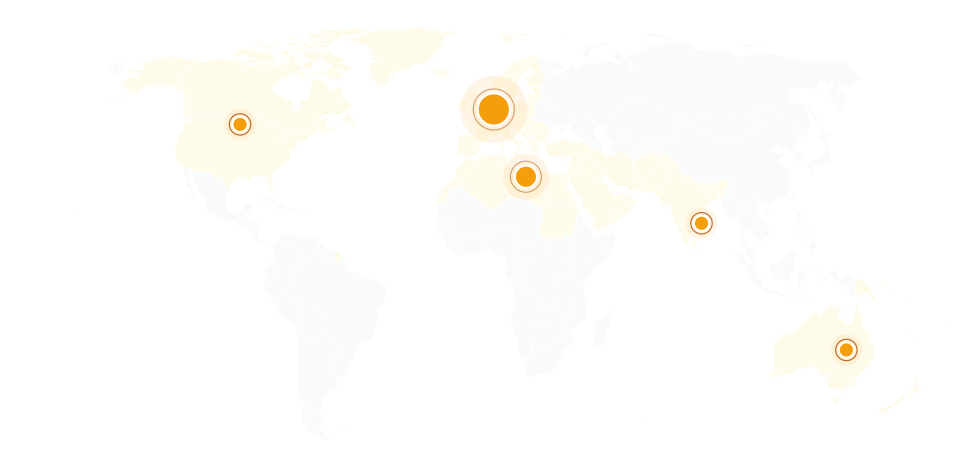
Major presence in Europe; Moderate presence in Middle East & North Africa; Minor presence in North America, South Asia, and Oceania; no recorded presence in Latin America, Central Asia & CIS, Sub-Saharan Africa, East Asia, and Southeast Asia.
Cell & System Architecture
Cell chemistry
Cell format
SolarEdge’s BMS tracks battery State of Health by measuring full-pack energy and tracks State of Charge as a percent of available capacity. It also reports battery power, energy, and status.
Management Systems (ISO)
The BESS vendor possesses the ISO certificates Quality Management (ISO 9001), Environmental Management (ISO 14001), Occupational Safety (ISO 45001), Testing and Calibration (ISO 17025), Information Security (ISO 27001) and Energy Management (ISO 50001).
ESG & Sustainability
SolarEdge has an EcoVadis Silver Medal, an ISS ESG Prime rating in the top 10% of the global electronic-components sector, a Sustainalytics ESG Risk Rating of 15.3, and an MSCI ESG Rating of A. By 2030, it aims to cut Scope 1, 2, and 3 emissions intensity by 5% from a 2025 baseline, and in 2025 it recycled or recovered 64% of waste and ran on-site supplier-code audits at five contract-manufacturer sites and eight major raw-material suppliers.
Market Price Estimate
No modelled range is published for this product yet.
Financial Health
Derived from the five sub-metrics below: 1 moderate · 2 suboptimal · 2 healthy.
Corporate & Listing
Reference Project
Recent Developments
SolarEdge launched US orders for Nexis, a modular residential solar and storage platform that combines battery storage and energy management to simplify installation and support flexible deployment.
The rest of this vendor profile is for members
Create a BESSBASE.com account to open and compare full vendor details. No subscription fee. Access is immediate.
Compare to Other Vendors
All vendors| Vendor | Tier | HQ | Capacity | Compare |
|---|---|---|---|---|
| Tier-2 | Herzliya, Israel | 2-20 GWh | This vendor | |
| Tier-2 | Shenzhen, China | 0.2-1 GWh | ||
| Tier-2 | Shenzhen, China | 2-20 GWh | ||
| Tier-2 | Suzhou, China | 0.2-1 GWh | ||
| Tier-2 | Nürtingen, Germany | 2-20 GWh |
How to Read the SolarEdge Vendor Page
This profile of SolarEdge is assembled exclusively from public data to support early-stage screening. Main source: corporate.solaredge.com
BESSBASE analyzes the published financials of SolarEdge on a quarterly basis to produce the Financial Health Scorecard. The scorecard for SolarEdge is Neutral, based on the cumulative score of five components: Balance-sheet strength Moderate, Profitability Suboptimal, Leverage Suboptimal, Liquidity Healthy, and Cash-flow risk Healthy. The BESSBASE Research Team estimates all five components from the latest public financial statements of SolarEdge, assessed relative to peers and corporate structure.
The Neutral score indicates that the BESSBASE Research Team does not find a clear basis for either a favorable or an unfavorable view on the manufacturer's financials. The Financial Health Scorecard is not a direct proxy for the bankability rating for SolarEdge energy storage products. It may form one input among others in a bankability assessment, or it may not, depending on the lender, project structure, and other factors.
Tier-2 is assigned when the BESSBASE Research Team cannot validate from public data that the energy storage products of SolarEdge robustly and repetitively obtain external financing from major financial institutions.
The BESSBASE Vertical Integration scorecard for SolarEdge is Highest. It reflects the assessment of the supplier's production capabilities of the key Technology & Supply Chain components: PCS, Energy Management Software, Battery Management Software, and Battery Cell.
Always confirm these terms and technical specifications directly with the vendor and project stakeholders. Reflect all agreed-upon details in the legal agreements before making any investment decisions.