Annual production capacity
0.2-1 GWh/yr
Bankability influence
Overall Positive
How the supplier's financials affect its products' bankability
Company Size
Large
1000-10000 headcount
Vertical integration
Medium
In-house production of key components
Company Overview
Founded in 2007, Deye makes technology products and is based in Ningbo, China. It runs R&D, design, production, sales, and service, has more than 600,000 square meters of workshops in Ningbo, Jiaxing, and other sites, and listed on the Shanghai Stock Exchange in 2021, as the global residential energy-storage market shipped 26.6 GWh in the first three quarters of 2025.
Headquarters
Ningbo, China
Legal entity
Ningbo Deye Technology Co., Ltd.
Integration footprint
China
Adjacent product lines
cloud or digital services, EV charging, solar PV, residential storage
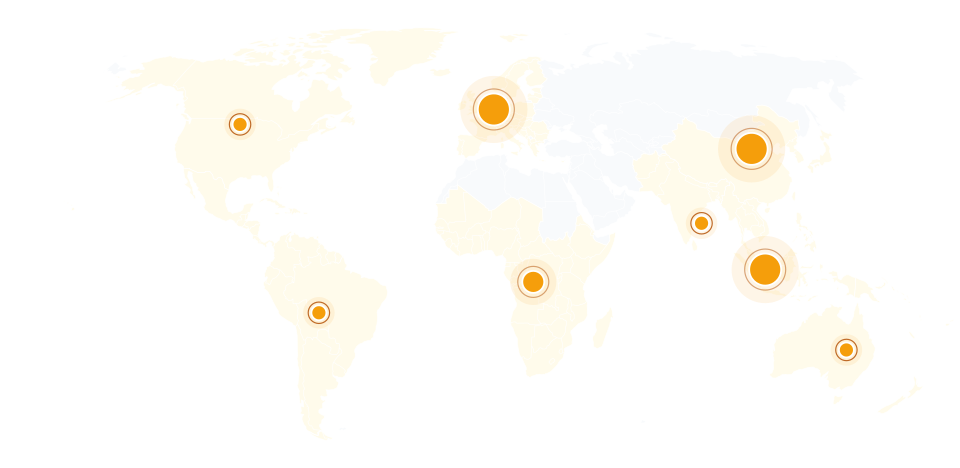
Major presence in Europe, East Asia, and Southeast Asia; Moderate presence in Sub-Saharan Africa; Minor presence in North America, Latin America, South Asia, and Oceania; no recorded presence in Central Asia & CIS and Middle East & North Africa.
Cell & System Architecture
Cell chemistry
Cell format
Deye’s BMS tracks cell and module voltage, current, and temperature, balances cells, and estimates battery state of charge and state of health. Its software lets operators check SoC, SoH, voltage, and temperature.
ESG & Sustainability
Deye recycles waste and saves resources. It says it set up environmental systems across its production facilities to cut environmental impact and support sustainable operations.
Market Price Estimate
No modelled range is published for this product yet.
Financial Health
Derived from the five sub-metrics below: all five healthy.
Corporate & Listing
Reference Project
Recent Developments
Deye launched a modular 2.5 MW commercial and industrial BESS with 100 kW or 125 kW power conversion units, lithium iron phosphate batteries, and zero millisecond switching.
The rest of this vendor profile is for members
Create a BESSBASE.com account to open and compare full vendor details. No subscription fee. Access is immediate.
Compare to Other Vendors
All vendors| Vendor | Tier | HQ | Capacity | Compare |
|---|---|---|---|---|
| Tier-2 | Ningbo, China | 0.2-1 GWh | This vendor | |
| Tier-2 | Shenzhen, China | 0.2-1 GWh | ||
| Tier-2 | Shenzhen, China | 2-20 GWh | ||
| Tier-2 | Suzhou, China | 0.2-1 GWh | ||
| Tier-2 | Nantong, China | 0.2-1 GWh |
How to Read the Deye Vendor Page
This profile of Deye is assembled exclusively from public data to support early-stage screening.
BESSBASE analyzes the published financials of Deye on a quarterly basis to produce the Financial Health Scorecard. The scorecard for Deye is Overall Positive, based on the cumulative score of five components: Balance-sheet strength Healthy, Profitability Healthy, Leverage Healthy, Liquidity Healthy, and Cash-flow risk Healthy. The BESSBASE Research Team estimates all five components from the latest public financial statements of Deye, assessed relative to peers and corporate structure.
The Overall Positive score indicates that the BESSBASE Research Team concludes, based on the last-quarter financials, that the manufacturer is likely to continue fulfilling its financial obligations for the typical duration of the procurement, shipment, and contractual period of a newly contracted BESS project. The Financial Health Scorecard is not a direct proxy for the bankability rating for Deye energy storage products. It may form one input among others in a bankability assessment, or it may not, depending on the lender, project structure, and other factors.
Tier-2 is assigned when the BESSBASE Research Team cannot validate from public data that the energy storage products of Deye robustly and repetitively obtain external financing from major financial institutions.
The BESSBASE Vertical Integration scorecard for Deye is Medium. It reflects the assessment of the supplier's production capabilities of the key Technology & Supply Chain components: PCS, Energy Management Software, Battery Management Software, and Battery Cell.
Always confirm these terms and technical specifications directly with the vendor and project stakeholders. Reflect all agreed-upon details in the legal agreements before making any investment decisions.


